
How Lemon Grove Residents Are Found
Lemon Grove records split by question. A street or parcel points first to the San Diego County Assessor/Recorder/County Clerk, or ARCC, and SanGIS. A recorded deed, lien, or easement runs through the Recorder's Official Record Search. A court name belongs in the San Diego Superior Court index. A household from an earlier decade is more likely to appear in a directory, newspaper, census, or archive than in a current city roster. City Hall keeps another layer: council and commission records, contracts, correspondence, permits, planning files, code cases, and clerk records.
Choose two anchors before searching. A full name becomes more useful with an approximate age, middle initial, spouse, business, parcel, or known address. An address becomes more useful with a year range and a legal description. Ownership does not prove occupancy. Voter information is restricted, vital copies have eligibility rules, and public files omit many private household details. A Lemon Grove residents directory search works best when each lead is tested against a second record created for a different purpose.
- Define the goal and the time frame. Decide whether the question concerns a current parcel, a past household, a family connection, an estate, or a public filing.
- For a street or parcel, start with ParcelQuest or SanGIS. Record the situs address, APN, map position, and any city-boundary question before moving to names.
- For a deed, lien, easement, or release, search the ARCC index by party name and recording dates. Use the in-person kiosk when the needed search is APN-based.
- For one person, compare the court index, vital-record route, business or license filing, and a directory or newspaper lead. Treat each result as a clue, not a final identity match.
- When an online path stops, call the custodian, use a public terminal, send a focused City of Lemon Grove request, or ask a library or archive for the right shelf.
Where Lemon Grove Resident Records Live
ARCC is the county-level spine for three different record functions. The Recorder indexes deeds, deeds of trust, reconveyances, liens, releases, easements, and maps. The County Clerk handles public and confidential marriage records, fictitious business names, notary authentication, and other clerk filings. The Assessor connects parcels to assessed ownership, maps, values, sale listings, characteristics, and historical tax information. Those roles overlap in a search, but they do not answer the same question.
San Diego County Recorder
ARCC service hub and kiosks
San Diego County, CA
(619) 237-0502
San Diego County Clerk
ARCC service hub and clerk filings
San Diego County, CA
(619) 237-0502
San Diego County Assessor
ARCC property-record channels
San Diego County, CA
(619) 236-3771
Property Records and ParcelQuest
The Lemon Grove public-records request page separates City Hall material from county-held deeds, marriages, parcel ownership, court files, voter data, and Sheriff records. City Clerk Joel G. Pablo is listed at City Hall, 3232 Main Street, Lemon Grove, CA 91945, with (619) 825-3841 and jpablo@lemongrove.ca.gov. Requests can use the online portal, mail, or in-person delivery.
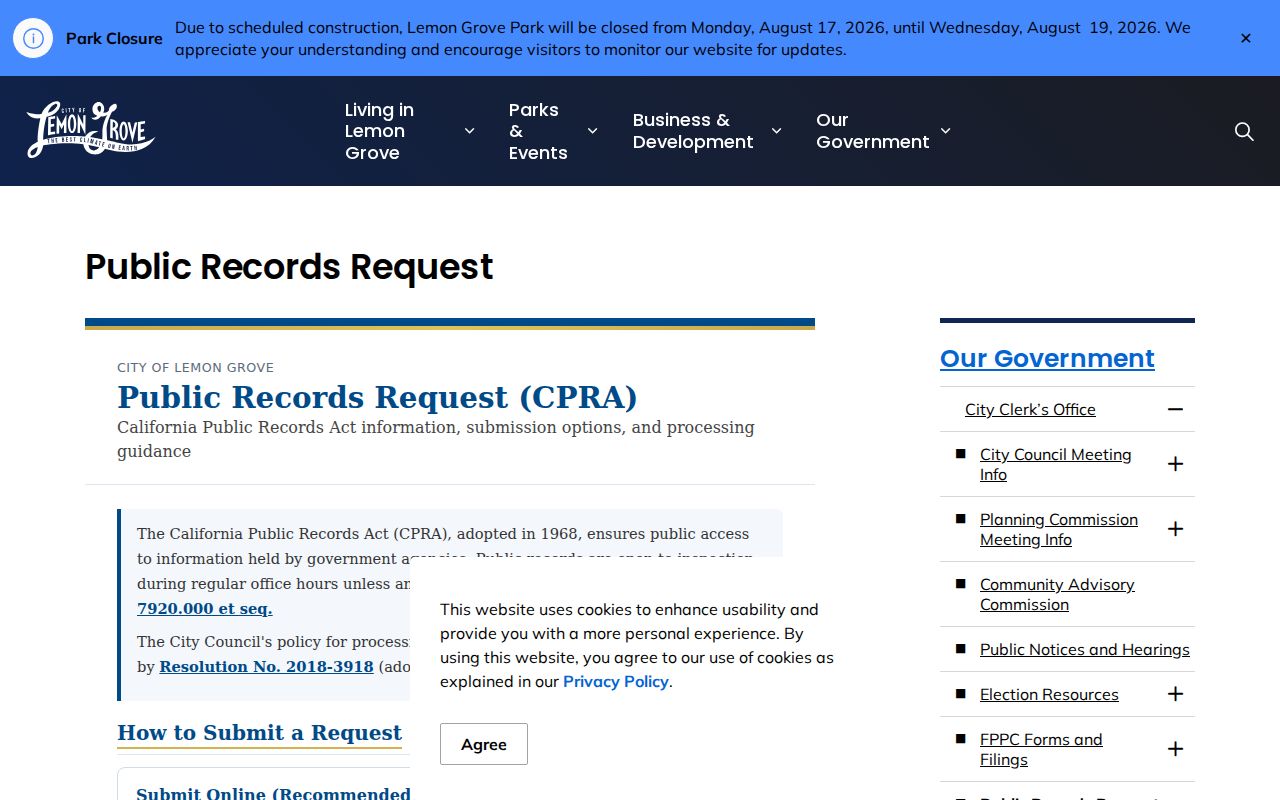
The Lemon Grove records-request image shows the city route for municipal files when a county portal is not the right custodian.
City Hall can provide existing identifiable records, but it does not have to create a new resident list or conduct open-ended research. Useful request terms include an address or location, department, record type, date range, permit or project number, agenda date, and subject. Electronic records already held by the clerk generally carry no charge when feasible; paper, media, and special-service charges follow the city fee schedule.
Lemon Grove ParcelQuest Fields and Limits
ParcelQuest Lite is reached through the ARCC property-records service. It is useful for a situs address, parcel map, APN, assessed characteristics, and related property detail, but ownership-by-name or address questions may need a phone call or a county kiosk. The official data source matters: a parcel page can describe land and assessment facts without proving who lives there.
The county permits 25 free ParcelQuest searches in a rolling 30-day period. Plan a name or address sequence before opening records, and do not treat the free allowance as a reason to build a casual list. The county page also describes phone, kiosk, web, mail, and copy channels, so an unsuccessful online search still has a documented next step.
The property-record screen is organized around these useful fields:
| Field | Type | Required | Format or Use |
|---|---|---|---|
| APN | Text | Alternative | County parcel number; an assessor mapping identifier |
| Street Address | Text | Alternative | Situs or property address |
| City | Text or dropdown | No | Lemon Grove can narrow a search, but GIS should confirm the boundary |
| ZIP | Text | No | 91945 is postal guidance, not proof of city jurisdiction |
| Search | Button | Required to submit | Uses a search under the rolling free-search allowance |
The ARCC property-record guidance distinguishes the situs address from the owner's mailing destination. A matching mailing and situs address may support an owner-occupancy lead, while a mismatch may point to another property, a business office, a trust, or a post-office box. Neither result proves current residence.
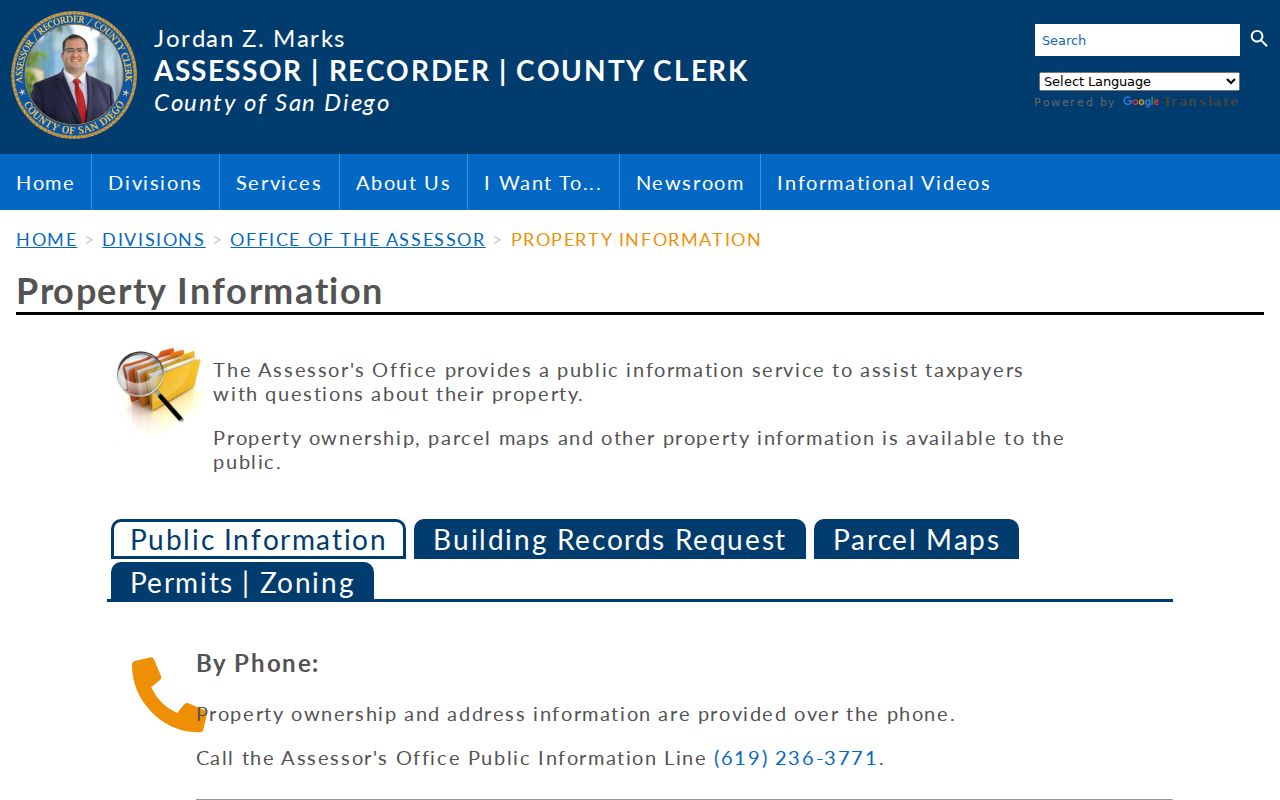
The county assessor image shows the official property-record route that complements a Lemon Grove residents directory search with parcel facts and access options.
Note: ParcelQuest's free threshold covers 25 searches in a rolling 30-day period, so plan queries before opening a parcel record.
Lemon Grove Deed Searches After APN Change
On December 9, 2024, ARCC removed APN searching from the web Official Record Search because of California AB 1785. The recorded documents were not removed. APN queries remain available at five in-person county kiosks, while party-name and date searches remain the practical online route for many deeds, liens, releases, easements, and maps.
For a parcel trail, use the Assessor or SanGIS to identify the current owner and legal description, then search the Recorder index by the grantee name and date range. A grantor is the party giving an interest; a grantee receives it. Compare the recording number, date, legal description, and party role before moving backward. If the web index ends at the wrong point, take the last book, page, party, or document number to a kiosk or counter.
Note: The public ARCC material does not state the live web index's first year, so no earlier coverage claim belongs in a Lemon Grove record search.
Current Lemon Grove Residents Directory Sources
No single current roll answers every Lemon Grove resident question. The useful source depends on whether the goal is ownership, a recorded transaction, a person's own registration status, a municipal filing, or a public business affiliation. The access route also matters, since some records are open online while others require a request, a call, a kiosk, or a statutory purpose.
| Source | What It Can Show | Keeper | Access Channel |
|---|---|---|---|
| Assessor roll and ParcelQuest | Owner, APN, situs, values, characteristics | SDARCC Assessor | Web, phone, kiosk, mail, copies |
| Official Record Search | Parties to deeds, liens, releases, easements, maps | SDARCC Recorder | Free index, copies, kiosk for APN |
| My Voter Status | One voter's registration status and polling information | California Secretary of State | Personal identity form, not an open roll |
| City clerk and planning files | Applicants, officials, correspondents, permits, projects, dates | City of Lemon Grove | Portal, mail, in-person request, inspection |
| Public business and license filings | Entity names, agents, license status, public affiliations | State and county custodians | Official search pages and filing requests |
A property result answers an ownership question. A recorded instrument answers who signed or received a document. A city permit may identify an applicant or agent at a site, while a business filing may connect a public name to an entity without proving residence. These distinctions keep a resident directory useful without turning one source into a claim it cannot support.
Business and professional records add a public-affiliation layer. bizfile Online can show an entity name, number, status, agent or address, and filings; a County Clerk fictitious business-name filing can connect a storefront name to a registrant; California Department of Consumer Affairs Search can show license status and related discipline links. An agent for service is not necessarily an owner, and a mailing address is not necessarily a residence.
Why Lemon Grove Voter Rolls Stay Restricted
California's My Voter Status tool is for a voter to check their own registration and polling information. It is not a public name search. California Elections Code section 2194 limits voter-file access to election, scholarly, journalistic, political, or governmental purposes, and commercial use is prohibited. A county file request asks for the applicant, organization, purpose, intended use, security agreement, and signature.
An approved file can contain names, registration dates, residence and mailing addresses, precincts, contact information, party preference, and optional voting history that identifies election type and voting method, not ballot choices. Driver-license or state-ID numbers, the last four Social Security number digits, unique identifiers, and signatures are excluded under section 2194(b). Safe at Home participants and other confidential voters have added protections.
For personal verification, use the California My Voter Status form or ask the Registrar of Voters what it can release for a documented purpose. A registration address is evidence of the address supplied by a voter, not a real-time occupancy statement.
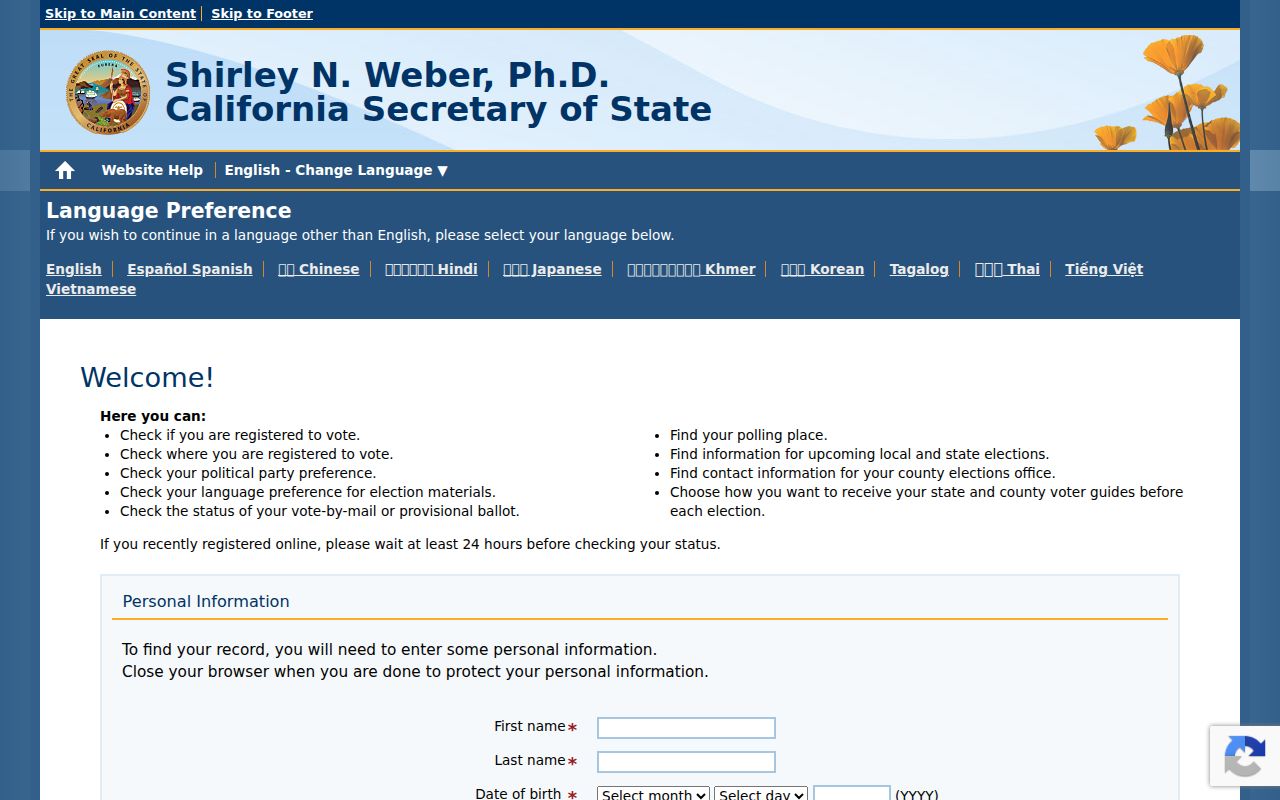
The California voter-status image reinforces the key distinction: a personal verification tool belongs in a careful Lemon Grove residents directory workflow, not in a casual street list.
Lemon Grove Court Index Hits Need Context
The San Diego Superior Court index covers civil, criminal, family, mental-health, and probate cases for Lemon Grove. Its party search can return a case title, case number, case location, case type, filing date, and parties. The index is a finding aid. It does not supply every charge, pleading, order, or disposition, and a same-name result needs an address, date, middle initial, or other independent anchor.
The San Diego Superior Court Index excludes juvenile, traffic and minor-offense material, and cases before 1974. Older material may be on courthouse microfilm for self-research, but staff do not perform the search. Some eligible civil, small-claims, probate, and family images can be ordered through the court's online or mail copy routes. Federal cases belong in the federal court system, not the county index.
Note: A court index entry can remain after dismissal, so the entry alone cannot establish disposition, wrongdoing, or liability.
Lemon Grove Mailing and Situs Clues
Parcel research uses several address types that should not be blended. The situs address identifies the physical land for assessor, permit, and map work. The mailing address is where assessment notices go and may point to another property, a business, a trust, or a post-office box. A legal description identifies the land in the recorded instrument and can bridge an old lot, block, subdivision, renamed road, or missing street number.
SanGIS is the map check. Search or zoom to the address, turn on parcel and jurisdiction layers, click the polygon, and record the APN before asking ARCC to verify ownership. A postal city label can cross an incorporated line. ZIP 91945 is associated with Lemon Grove, but a ZIP does not prove that a parcel is inside the city, subject to city permits, or served by the same agency. Confirm the boundary before routing a request. Once the APN is known, the full address-by-address walk belongs in the Lemon Grove street directory workflow.
Finding Lemon Grove Heirs Through Records
An heir or deceased-resident search should move from a name to an event, then to an estate or title record. A death record can support the date and place of an event. An obituary can identify relatives and a service. A probate index can lead to petitions, orders, or a representative. The Recorder can then show a deed into a trust, personal representative, or later owner. Each step has a different custodian and a different privacy rule.
San Diego County ARCC and the California Department of Public Health issue birth, death, and marriage records through separate county and statewide channels. CDPH lists 2026 fees of $31 for a birth copy, $26 for a death copy, $19 for a marriage copy, and $18 for a dissolution certificate of record. Informational copies are available more broadly, while an authorized certified copy requires statutory eligibility and a sworn statement; a mailed authorized request generally needs notarization. Confidential marriage records are limited to a party or court order under Family Code section 511. Use the California vital-record applications rather than treating a directory entry as proof.
Official Rolls Versus Commercial Compilations
Commercial compilation is a category, not a custodian. Such services may merge public filings with purchased or user-supplied data, then present a paid profile whose source trail is hard to inspect. Official rolls and indexes are narrower, but their creator, access rule, and correction path are clearer. The comparison matters when a name or address result will shape family research, a property question, or a safety decision.
| Question | Official custodian record | Commercial compilation category |
|---|---|---|
| Source | Created by ARCC, the court, the city, a library, or another named office | Mixed feeds with uneven provenance |
| Address meaning | Situs, mailing, recorded-party, or registration address has a defined context | May merge stale or conflicting addresses |
| Access | Portal, kiosk, inspection, mail, copy order, or statutory request | Account or paywall, with terms set by the provider |
| Verification | Ask the custodian for the index, image, file, or correction route | Must be checked against the originating office |
| Best use | Genealogy, civic review, parcel history, and documented public-record research | Lead only, never the final authority |
A commercial profile can be wrong even when every component came from a real record. Prefer the named office, preserve the date searched, and avoid republishing sensitive details that a source restricts. California privacy rights may provide deletion, correction, or opt-out paths where the law applies, but an official record must be addressed through its own custodian.
Lemon Grove Library and Archive Trail
The Lemon Grove branch at 3001 School Lane is a local referral point. Staff can help locate county-library databases, yearbooks, telephone books, local newspaper files, and genealogy tools, or direct a request to the stronger regional shelf. The branch lists Monday hours from 10 to 6, Tuesday noon to 7, Wednesday and Thursday 10 to 6, Friday and Saturday 10 to 5, and Sunday closed, with (619) 463-9819 and lemongrovelibrary@sdcounty.ca.gov.
The San Diego Public Library California Collection holds city directories from 1886 through 2021, the San Diego Union run from 1868, the San Diego Great Register for 1888-1892, maps, and Sanborn material. The City of San Diego Digital Archives offers selected 1874 and 1926-1960 volumes, including separate suburban directories for 1955-1960. The Lemon Grove Historical Society collection adds digitized local texts from the 1940s through the 1990s, while its offline archive may hold family, school, photograph, and organization material.
Use the Lemon Grove Library contact page for current branch details, then ask for a specific year, surname, street, newspaper date, or organization. Exact Lemon Grove reverse-directory, obituary, cemetery, church-register, and Sanborn-sheet holdings were not fully inventoried, so a staff confirmation is part of a sound search.
Lemon Grove Historical Directory Collections
Lemon Grove incorporated on July 1, 1977. Earlier records can therefore sit under San Diego County, a rural route, a subdivision, a suburban community, or a regional directory heading rather than a city archive. The 1955-1960 San Diego suburban directory sequence is especially useful for that pre-incorporation period. It can place a name, address, spouse, occupation, business, or nearby household in context without pretending that a directory is a title record.
Lemon Grove's citrus-agriculture history and "Best Climate on Earth" civic branding can guide newspaper, business, and directory searches for growers, grocers, packers, and transport-linked residents. The 1931 Lemon Grove Incident is another archival context; family research tied to it should be handled with care and checked against contemporaneous newspapers and society collections.
Alphabetic entries and criss-cross sections work together. A name search may give an address; the street-order section may reveal another occupant or business at that address. Move one volume earlier and later, preserve initials and old address wording, and pair a directory lead with a deed, census, newspaper, probate file, or permit. The expanded collection treatment belongs with the Lemon Grove city directories and their year-by-year access notes.
Note: Exact Lemon Grove reverse-directory holdings are not fully inventoried, so library staff should confirm a desired year before a research visit.
Lemon Grove Residents Directory Glossary
Four terms recur across ARCC, assessor, court, and library records. Their limits matter because a label can sound more complete than the underlying record.
- Roll
- An organized list kept for a defined purpose, such as an assessor property roll or a voter file. It does not list every person connected to a place.
- Index
- A pointer to a document, case, or filing. An index entry can identify parties and dates without containing the full record or its final result.
- Criss-cross directory
- The street-order part of a directory. It reverses the alphabetic name arrangement so a researcher can start with a house number or street.
- Parcel
- A mapped unit of land identified by an APN. A parcel is not a household, and its assessed owner is not automatically its current occupant.
- Situs address
- The physical address used to locate land for map, assessor, and permit work. It differs from a mailing address and a recorded legal description.
Defining the record before using it prevents a common error: treating an owner, an indexed party, an occupant, and a voter as interchangeable descriptions of one person.
Lemon Grove Records and Lawful Use
California's Public Records Act, Government Code section 7920.000 and following, allows a person to request identifiable state or local records without a special form in most cases. An agency ordinarily makes a disclosure determination within ten calendar days and may add a written extension of up to fourteen days for unusual circumstances. That timing is a decision deadline, not a promise that production will be complete. Inspection is ordinarily free, while direct duplication costs and limited electronic work may apply.
Privacy limits remain part of the records map. City files may be redacted under privacy, law-enforcement, security, draft, or privileged-record exemptions. Safe at Home can give qualifying participants a substitute mailing address and confidential voter treatment under Government Code sections 6205-6211. The California Attorney General's privacy guidance also describes address confidentiality, deletion requests, and the 2026 data-broker DROP process. Such protections explain why a lawful search may end with a gap.
Lawful personal use. Lemon Grove records support genealogy, civic review, property history, estate work, and reconnecting with relatives or classmates. Do not use a name or address to stalk, harass, intimidate, threaten, or harm anyone, and respect every statutory access and confidentiality limit.