
Lemon Grove Previous Residents by Era
An address history works best when sources are sorted by what they can prove. A recorded deed names parties to a transfer, while a directory places a person at an address for one edition. A census describes a household at an enumeration point, and a permit dates a project or names an applicant. The eras below are practical, not a promise that every year has a surviving Lemon Grove volume. ARCC does not state the first year of its live web index, and no official finding aid inventories every reverse-directory or Sanborn sheet. Those gaps should stay visible in a careful history.
| Source | Years It Covers | Where Held | What It Shows |
|---|---|---|---|
| Recorder index and deeds | First web year not stated; APN web search ended December 9, 2024 | ARCC Official Record Search; five kiosks, counter, mail copies | Grantor/grantee, recording date and number, legal description, transfers |
| San Diego directories | 1886-2021 on shelf; selected digital volumes from 1874 and 1926-1960 | SDPL California Collection | Occupants, addresses, businesses, occupations |
| San Diego suburban directories | 1955-1960 | City of San Diego Digital Archives | Pre-incorporation Lemon Grove entries and house-number clues |
| Federal census | Schedules through 1950 public as of 2026 | National Archives and library databases | Household members, ages, relationships, addresses and locations |
| Lemon Grove permits and Address Request files | City-era and transferred files; exact start not posted | Community Development counter and city CPRA request | Applicants, owners or agents, projects, address changes and dates |
| Historical Society texts | 1940s-1990s digital; broader archive offline | California Revealed and Lemon Grove Historical Society | Local names, institutions, images and community narratives |
| San Diego Union and probate leads | Newspaper collection from 1868; case coverage varies | SDPL Special Collections and San Diego Superior Court | Obituaries, notices, death clues and estate transitions |
Use the row that matches the question. ARCC is the first stop for title, the county and regional shelves are stronger for historical occupants, and municipal files can explain when a number or structure changed. San Diego County's deed, court and vital-record trail predates Lemon Grove's July 1, 1977 incorporation, so older evidence may sit outside a city heading. A previous resident may vanish because an edition skipped a year, a name was abbreviated, or the address moved under a county or suburban heading.
Lemon Grove Previous Residents: APN to Grantor
Present-day deed work begins at a parcel, not a surname guessed from a street book. Search SanGIS to confirm the incorporated line, zoom to the target parcel, and record the APN. The assessor's ParcelQuest Lite route accepts an APN or situs street address and can show parcel characteristics, assessed value and map data. The official assessor property-records page directs ownership and address questions to phone or public kiosks, so call (619) 236-3771 when a web result does not expose the needed owner or mailing destination. The page also lists mail access for property records. The mailing address and situs address answer different questions.
The San Diego County Assessor/Recorder/County Clerk hub identifies the county offices that divide parcel, deed and clerk work for a Lemon Grove house history.
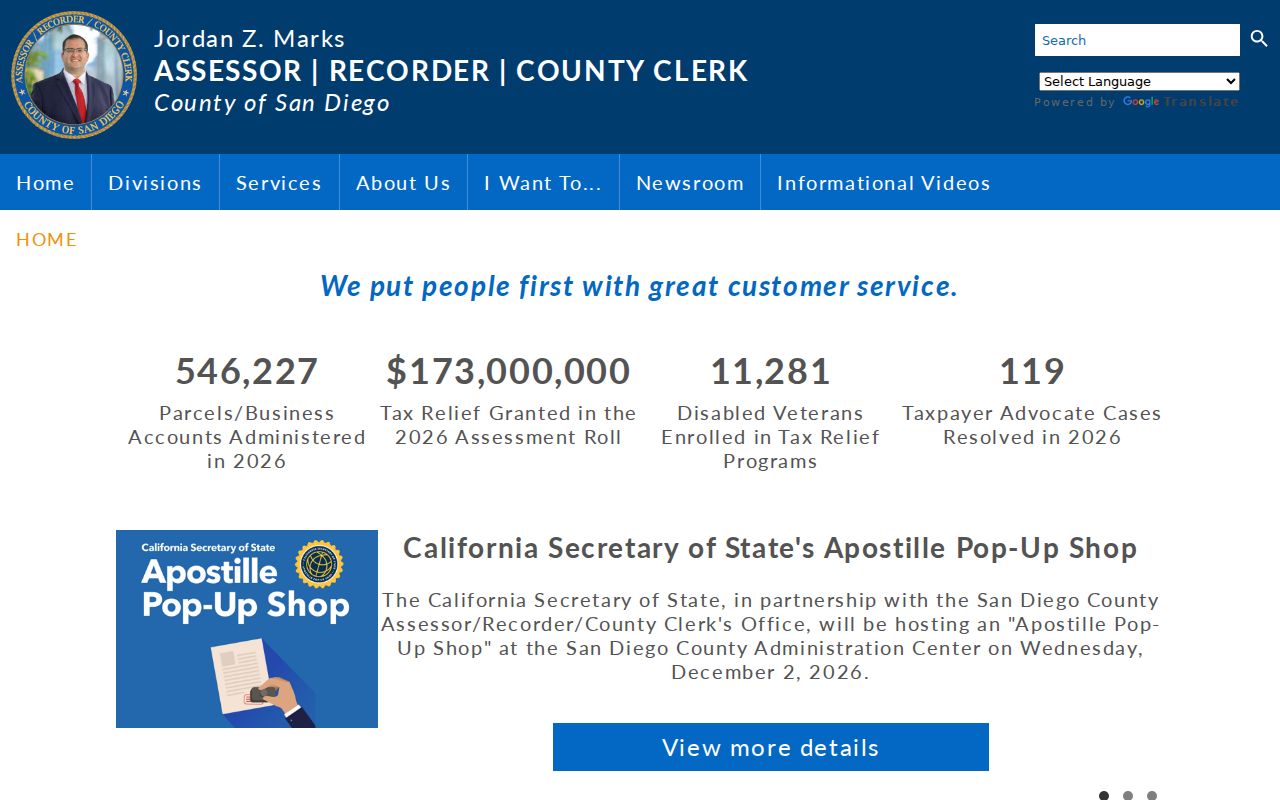
That separation matters: an assessor result can identify a current title lead, but the Recorder supplies the recorded instrument that connects one party to the next.
Once the APN, current assessed owner and legal description are in hand, walk backward in this order:
- Confirm the city jurisdiction and APN in SanGIS or the assessor map. A postal Lemon Grove label alone is not enough.
- Obtain the assessed owner and legal description through ParcelQuest when available. If ownership or address information is not exposed, use the assessor phone route or a public kiosk.
- Search the owner's name as grantee in the Official Record Search, narrowing by recording date and document type. Save the grantor, recording number and date, book and page when shown, and the legal description.
- Search that grantor as an earlier grantee. Compare the legal description, map, lot or block, and date before accepting a match.
- Repeat the grantor-to-grantee turn until the online party or date trail ends. Carry the last citation to an ARCC kiosk or counter, or order a copy by mail.
- Keep the title chain separate from the occupant trail. Move to directories, census schedules, permits and newspapers when the question is who lived there.
- APN
- An assessor parcel number that identifies mapped property; it is not the legal description and may change after a split or merger.
- Grantor / grantee
- The grantor transfers an interest; the grantee receives it. In a backward chain, today's grantee points to yesterday's grantor.
- Chain of title
- The ordered set of recorded transfers used to connect one title holder to earlier parties.
- Legal description
- The recorded land identity, such as a map, lot, block or metes-and-bounds description, that can bridge an old address.
- Enumeration district
- A census collection area used to organize schedules; it helps locate a 1950 household when a modern street number does not match.
Note: The recorder index shows a recorded instrument's parties and date, not a complete account of who lived at the address.
Lemon Grove APN Search Changed in 2024
On December 9, 2024, ARCC removed APN searching from the online Official Record Search after California AB 1785. The documents were not destroyed; the parcel-number route moved to five county in-person kiosks. Party-name and date research remains an online path, so a deed trail can still begin with the assessed owner and then move through grantors. The change matters when a street address is known but no party name is known.
The ARCC recording rules and search-change notice show the current split between web and counter access for a Lemon Grove previous-resident search.
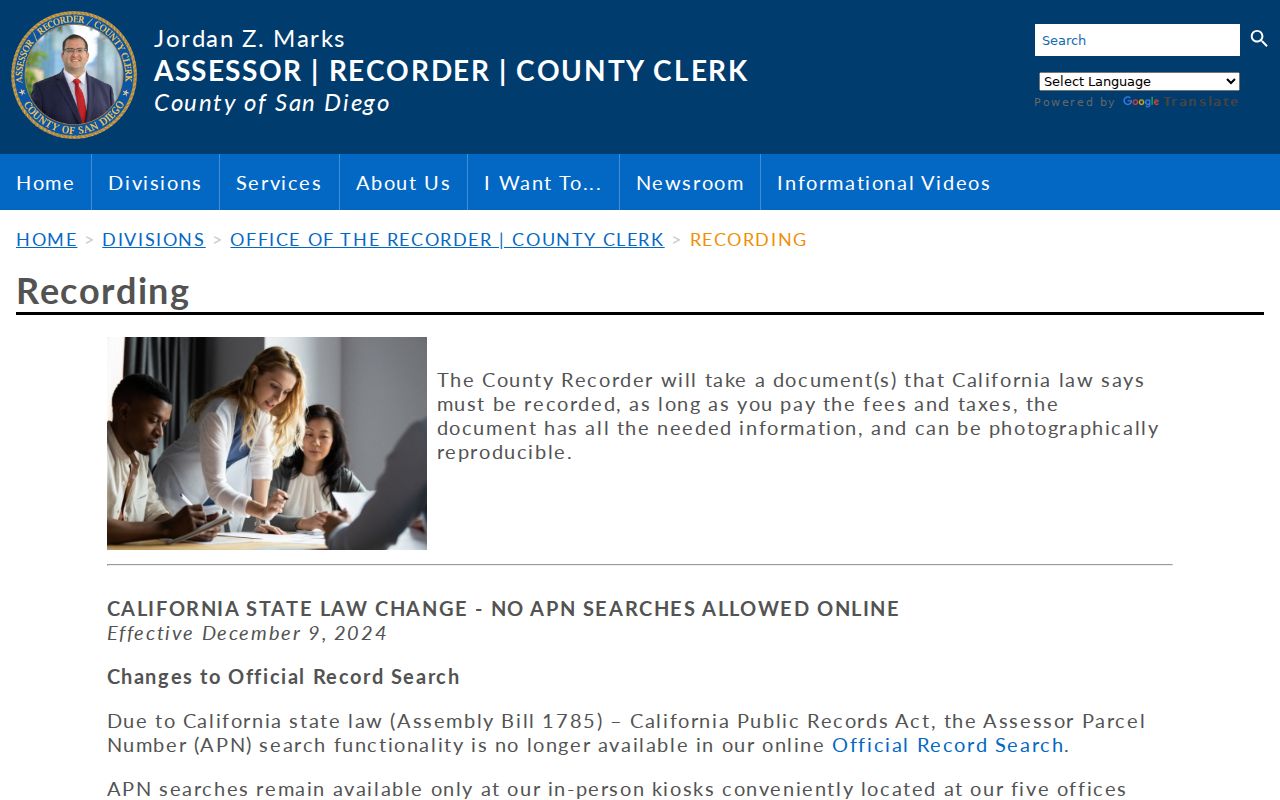
The screenshot's practical lesson is simple: use names, dates, document type, document number, or book and page online, then use the kiosk when the APN is the only reliable key.
- Online fields: party name or last name, first name, document type, recording date range, document number, and book or page mode.
- In-person field: APN searching at five county kiosks, with the counter as a fallback when the chain needs staff guidance.
- Copy route: use the Recorder's copy-order channel or ask at the counter when an indexed citation needs the underlying instrument.
ParcelQuest Lite allows 25 free searches in a rolling 30-day period. That limit makes a focused one-address workflow more sensible than broad enumeration. The Assessor can be reached at (619) 236-3771, the Recorder/Clerk at (619) 237-0502, and ARCC lists ARCCHELP@sdcounty.ca.gov for service questions.
Lemon Grove Previous Residents Need Two Timelines
Ownership and occupancy overlap, but they are not the same record. Deeds show a recorded transfer. Directories and census schedules show people associated with an address at a particular time. A permit can name an applicant, owner or agent without proving that the person lived at the site. Keeping the tracks apart prevents a title holder from being mistaken for every past household, and it keeps a directory entry from being treated as a deed.
| Timeline | Start point | Best evidence | What it can show |
|---|---|---|---|
| Owner and title | Current APN and assessed owner | Assessor roll, Official Record Search, recorded deed | Named parties, transfer dates, vesting language and legal description; not necessarily occupancy |
| Occupant and household | Directory or census address | 1955-1960 suburban volumes, other directories, census, newspapers | People and businesses tied to an address for a point in time; not certified ownership |
| Address and structure | Legal description or permit location | Recorded maps, Address Request, planning and permit files | A bridge between an old parcel identity, a changed number and a later address |
Situs means the physical parcel used for property and map work. A mailing address is where assessment notices go and may be elsewhere, including a trust, business office or post office box. A match can support possible owner occupancy, but it does not prove who slept at the address. When the goal is a current by-address pass, the Lemon Grove street address directory handles the present parcel chain; past residents require the second, historical track.
1955-1960 Lemon Grove Directories
The separate San Diego suburban directories for 1955, 1956, 1957, 1958, 1959 and 1960 are the strongest bridge years for Lemon Grove before incorporation. Lemon Grove remained unincorporated until 1977, so a search limited to a city-only heading can miss the people and businesses placed under a suburban or county section. The broader San Diego Public Library shelf spans 1886-2021, while the City Archives offers selected digital volumes from 1874 and 1926-1960.
The collection itself is described on the Lemon Grove city directories reference, but a house-history search uses the volumes differently. Start with an alphabetic entry when a name is known. Record the exact street wording, number, initials, spouse notation, business marker and any rural-route language. Then check the street or criss-cross section, which reverses the lookup into street name, house number and occupant or business. Move one issue earlier and one later. A first appearance brackets a possible arrival; a disappearance can mean a move, death or a gap in the run.
Directory entries vary by year. They can contain a surname, given name or initials, spouse in parentheses, occupation, home or business address, a later telephone number, and markers such as “r” or “h.” Read each volume's front-matter key before treating an abbreviation as evidence. No official finding aid located every Lemon Grove-specific reverse-directory volume, so ask SDPL Special Collections or the Historical Society before claiming an exhaustive run of addresses.
Pair Lemon Grove Directories with 1950 Census
The 1950 census is a useful household checkpoint for previous residents. Federal schedules through 1950 were public as of 2026 under the 72-year release rule; the 1960 census is scheduled for public release in 2032. Pairing does not make a directory entry perfect. It gives a second record for names, ages, relationships and location, especially when a directory lists only one contact or an abbreviated household.
Use the directory and census as a matched sequence:
- Copy the directory name and address exactly, including directional terms, old street forms, rural routes and subdivision wording.
- Search the 1950 schedule through a library database or federal census collection, using the place and likely enumeration district rather than forcing a modern number.
- Compare household names, ages, relationships and locations. A close match is stronger when the address language and nearby clues also align.
- Check a directory before and after 1950, then return to deeds for title and to newspapers for a move, death or community event.
- Mark uncertainty when the records disagree. A directory lists occupants and businesses, but it does not reliably distinguish an owner from every person present.
This pairing is most useful for family history and a documented house timeline. It is not a substitute for the recorder's legal description, and it should not be turned into a public list of living households.
Lemon Grove Permit Records Date an Address
Permit files can add a dated event between two directory appearances. Lemon Grove Community Development handles planning and permit questions at 3232 Main Street, (619) 825-3805, from 7:00 a.m. to 6:00 p.m. Monday through Thursday; the counter is closed Friday and appointments are recommended. Ask for an exact address and date range. A focused request may identify an applicant, owner or agent, project scope and work date, while privacy or other exemptions may limit fields that are released.
Useful city file types include building, encroachment, alarm, sign, boundary-adjustment, lot-merger, certificate-of-compliance, parcel-map and tentative-subdivision-map records. The Lemon Grove permit page supplies the public starting point, and the planning information page connects the counter to address and zoning materials.
- Use the street address and a narrow date range when the question is when work occurred.
- Use the project, map, lot or parcel clue when an old number does not match the current number.
- Use the city CPRA request route online, by mail or in person when a transferred file is not at the counter.
- Ask for existing identifiable records. The city supplies records it holds and does not have to create a new history list or conduct research.
An applicant name or permit date is a clue, not proof that a person occupied the property. Use it to anchor the next directory, newspaper, deed or map search.
Bridge Lemon Grove Records to Legal Descriptions
An address chain breaks when the same parcel is described in different ways. Lemon Grove records before 1977 may say unincorporated San Diego County, a rural route, a subdivision name or a nearby postal community. An APN is an assessor mapping identifier, not a legal description, and it is not necessarily permanent after splits or mergers. Recorded subdivisions may use map, lot and block references; deeds may use metes-and-bounds language instead.
Build the bridge by comparing the current deed's legal description with the prior deed, then matching the recorded map, lot, block or metes-and-bounds calls. Use SanGIS for geometry and jurisdiction, the assessor map for the parcel framework, the Address Request form for a missing or changed situs number, and planning or subdivision files for the local explanation. College Grove's annexation into San Diego away from the Lemon Grove area is a reminder that historical community names and current boundaries do not always align.
Note: A 91945 postal label can guide a search, but it cannot settle incorporated jurisdiction or historical identity.
Lemon Grove Previous Residents: Probate Endpoints
A title trail may end at a death, but the next record is often another beginning. Search the San Diego Superior Court index for a probate case, note the case location and date, and use the relevant business office, Register of Actions or copy route for the file. Some probate images in cases initiated January 1, 2008 or later may be purchasable online. Pre-1974 cases are absent from the public index and may require courthouse microfilm; court staff do not perform that older search.
Probate orders, personal-representative filings and deeds into a trust can explain why the next recorded owner differs from the last directory entry. Keep the court index in perspective: it is an index, not the disposition or the full file. Use the court's records access guidance for copy and microfilm routes.
For the household side, follow a disappearance into death indexes, cemetery sources, funeral-home obituary pages and the San Diego Union collection, which begins in 1868. SDPL access may be hard copy, microfilm or digital depending on the year. Search OCR with alternate spellings, spaced initials and street or business names. An obituary is a lead, not final proof, so compare it with vital, probate and deed records before closing the trail.
Lemon Grove Historical Records Beyond the Catalog
The Lemon Grove Historical Society supplies an uncataloged layer that can explain a name or address absent from a clean index. Its California Revealed partner collection offers digitized local texts from the 1940s through the 1990s, while the society's broader archive includes family files, photographs, school material, local organizations and address clues that may not be online. The society's archive and museum program is therefore a referral point, not a promise of a complete searchable roll.
Search digital metadata first with names, dates, institutions and street variants. Then approach the Historical Society with the exact clue, the suspected year and the item type. Its 1897 Parsonage Museum, built as Atherton Chapel and described as Lemon Grove's first local church, can add community context even when a specific register is not held. SDPL Special Collections remains the stronger regional fallback for directories, newspapers, maps, Sanborn material and genealogy databases.
The research record does not establish every Lemon Grove reverse-directory volume, obituary index, cemetery register, church register or local Sanborn sheet year. Treat an uncataloged lead as a prompt for a custodian inquiry, not as proof that a collection contains a particular family or address.
House-history boundary. Previous-resident research is appropriate for family history, genealogy, estate work and documenting a house. Treat living people with care. Do not use address records to stalk, harass, follow or threaten anyone; California Penal Code §646.9 and Code of Civil Procedure §527.6 address harmful conduct.