
Lemon Grove Resident Lookup Record Map
Lemon Grove is an incorporated city, but San Diego County holds most durable records that can identify a person. A useful resident lookup begins by matching the question to the record keeper. An assessor parcel can show ownership and a mailing destination, while a court index shows a named party and case details. Neither one alone proves that a person lives at a particular home.
| Record | What It Confirms | Where | Access |
|---|---|---|---|
| Assessor parcel | Ownership, mailing destination, parcel relationship | SDARCC, ParcelQuest, or kiosk | Public; occupancy is not proved |
| Recorded instruments | Named party, transaction, and date | ARCC Official Record Search | Public index; APN search at a kiosk |
| Voter status or file | Supplied residence, registration status, and precinct | Secretary of State tool or restricted file | Purpose limits under Elections Code §2194 |
| Court index | Same-named party, case type, date, and location | San Diego Superior Court | No juvenile or pre-1974 cases; index is not disposition |
| Vital records | Event relationships and dates | SDARCC or CDPH | Informational and authorized-copy rules |
| Business entity or FBN | Entity association, agent, address, and status | bizfile Online or ARCC County Clerk | Public filing; association may be stale |
| Professional license | Licensed name, number, status, and discipline link | DCA or the issuing board | Public; board fields vary |
| Custody or registry record | Published custody or statutory registry category | San Diego Sheriff, CDCR, or Megan's Law | Current or statutory limits apply |
| Directories and newspapers | Historical residence, occupation, spouse, or event | SDPL or Lemon Grove Historical Society | Collection-specific years and access |
| Unclaimed property | Name, reported address, and holder | California State Controller | Free search; claim proof is required |
Use the property and recorded-document rows when the question begins with an address or parcel. Use the court, vital, license, or business rows when it begins with a name or event. The directory and newspaper row is strongest for a past resident, while the custody and registry rows answer narrow category questions rather than broad character questions.
Lemon Grove Lookup: Two Identity Anchors
Two independent anchors keep a resident lookup from collapsing into a same-name guess. The first anchor is the person’s name as it appears in a record. The second is a separate detail that can be tested in another source. An approximate age, middle initial, known address, spouse, parcel, business, or public affiliation can serve as that second point. Preserve the original spelling while also trying reasonable variants.
- Write down the full name, including middle initials, hyphenated or former surnames, and diacritics. Keep each version separate.
- Choose one independent anchor, such as an approximate age, a known Lemon Grove address, a spouse, or a parcel relationship.
- Run the source with the narrowest useful fields. Compare the date, court location, address, business role, or event place rather than accepting a name alone.
- Confirm the match in a second custodian record. Keep the source date and record type, and do not publish protected information simply because it was found.
An assessor owner is not necessarily an occupant. Compare the situs address, which locates the land, with the mailing address used for assessment notices. A mismatch may point to another property, a business office, a trust mailing point, or a post office box. It does not prove who sleeps at the parcel. ARCC supplies ownership and address information by phone at (619) 236-3771, and a phone answer can be a useful fallback when an online field is missing.
- Docket
- The running court record for a case, including entries that help identify filings, dates, and later court action.
- Index versus image
- An index is a short description of a record. An image is a scan or copy of the underlying filing, and it may have a fee or access limit.
- Certified copy
- A copy that the custodian attests as an official copy. Ask for certification when an index entry or plain copy is not enough.
When an online record fails, call the direct office, use a public kiosk or terminal, submit a focused California Public Records Act request, search library microfilm and directory volumes, ask the historical society, and then consult a state or federal archive when the record has moved. A city request works best with the exact subject, date range, department, address, record type, permit or project number, and useful keywords.
San Diego Court Search Fields
The San Diego Superior Court Court Index is the state trial-court name route for civil, criminal, family, mental-health, and probate cases connected to a party. Lemon Grove has no separate city-operated municipal court. A party search works best after the two anchors are set, because common names can return only a limited selection. The index is free, but a document image or certified copy follows a separate route.
| Search mode/field | Type | Required | Options/format notes |
|---|---|---|---|
| Party Name Search | tab/mode | Not applicable | Name-associated cases; exact live fields should be screenshot-verified |
| Last Name / Business Name | text | yes in party mode | Use variants; common names return limited selections |
| First Name | text | no | Initials/aliases can alter results |
| Case Type | dropdown | no | Civil, Criminal, Family, Mental Health, Probate categories |
| Case Location | dropdown | no | Courthouse/location filter |
| Case Number Search | tab/mode | Not applicable | Year plus eight-digit sequence shortcut accepted |
| Case Number | text | yes in number mode | For XX-YYYY-########-CC-TT-LLL, enter YYYY######## without hyphens |
| DA Number Search | tab/mode | Not applicable | Criminal DA case number |
| Search | button | Not applicable | Result count limited; narrow criteria |
The San Diego Superior Court online case search returns a structural view of the search route used for a Lemon Grove resident lookup.
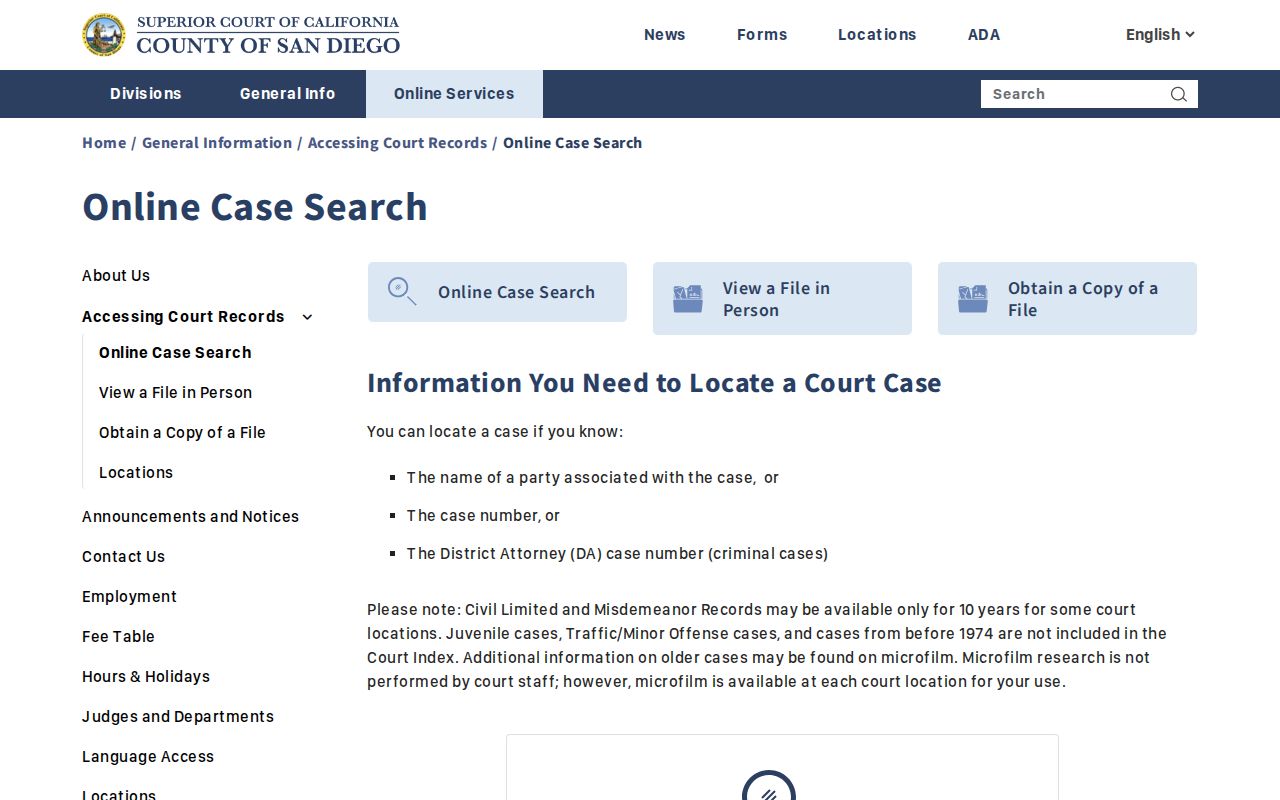
The screen is a starting index, not the full file. Note the case location before requesting a copy, because the relevant business office holds the file.
Federal litigation uses PACER for the U.S. District Court for the Southern District of California. A PACER account is the online channel, while courthouse clerks and public terminals provide a fallback. PACER charges per page under its current fee and exemption rules.
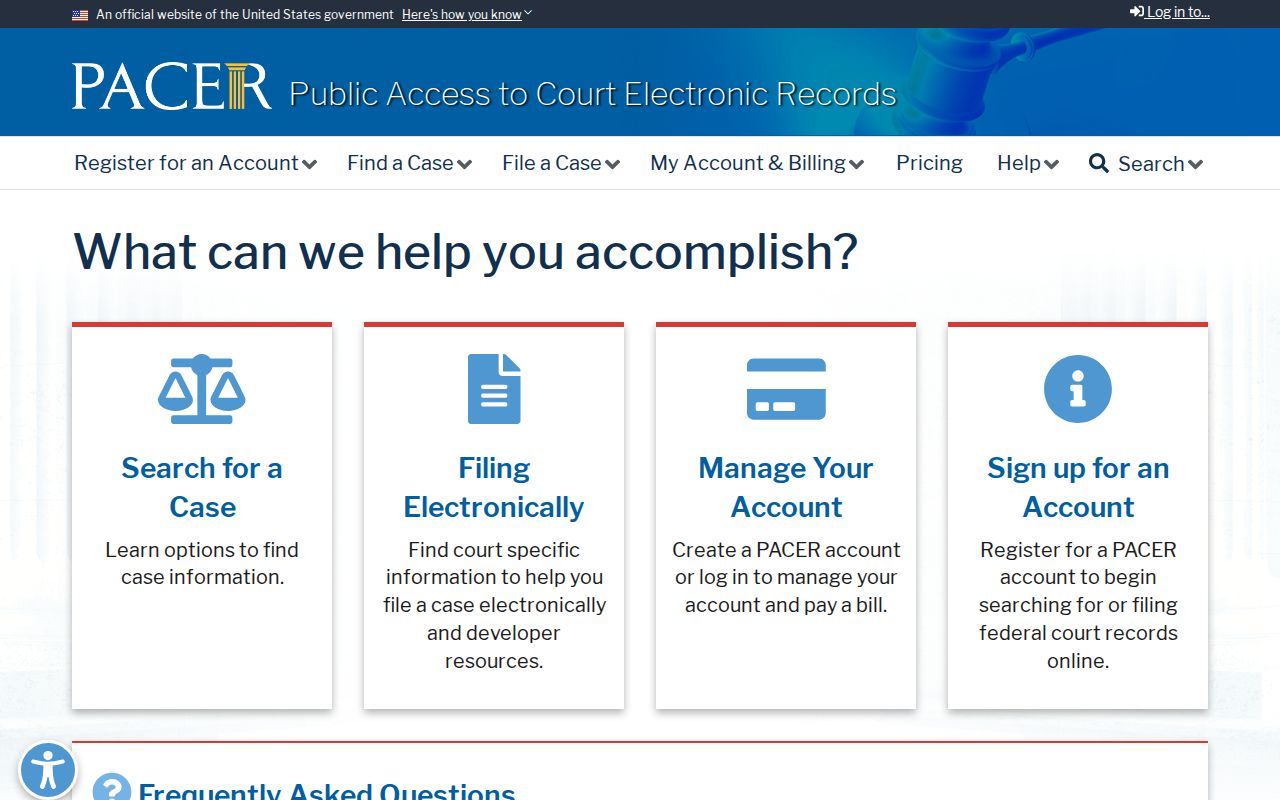
Federal and state court results should stay separate. A federal docket does not replace the San Diego Superior Court index, and neither proves that a party is the person being sought without a second anchor.
A court-index result can look conclusive while leaving out the fact a reader most wants to know. The returned inventory identifies a case, not the whole story. A name match is a lead for file review, not proof of wrongdoing, liability, or a particular outcome.
- Case title, which names the action or parties.
- Case number, the court identifier for the file.
- Case location, which points to the relevant business office.
- Case type, such as civil, criminal, family, mental health, or probate.
- Date filed, which places the case in time.
- Parties, which must still be compared with the second identity anchor.
The index does not provide charges or disposition. Disposition means the court’s outcome or ending action, so review the official file for that fact. Civil Limited and misdemeanor material may be available for only ten years at some locations. Juvenile, traffic or minor-offense, and pre-1974 cases are absent from the online index. Older material may survive on self-service courthouse microfilm, but court staff do not perform that research.
Criminal documents are viewed at the courthouse or requested by mail. Some civil, small-claims, and probate documents in cases started January 1, 2008 or later may be purchased through the Register of Actions. Some imaged family documents filed August 24, 2015 or later can be ordered online and mailed. A qualifying index entry can remain even after dismissal without a finding under California Rule of Court 10.851 and Government Code §68152(h)(15).
Note: A docket index can preserve a case entry after dismissal, so the official file matters before any conclusion about a person.
Lemon Grove Vital Copy Choices
Birth, death, and marriage records are not one open name index. San Diego County ARCC issues county birth, death, and marriage certificates, while the California Department of Public Health issues statewide records. The CDPH Vital Records service uses an informational-versus-authorized framework, and a divorce certificate of record is not the same as the Superior Court file.
| Record | Informational route | Authorized or limited route | 2026 fee |
|---|---|---|---|
| Birth | Informational copy with the identity disclaimer | Authorized persons under Health and Safety Code rules; sworn statement, generally notarized for a mailed authorized request | $31 |
| Death | Informational copy for a requester who does not claim authorized status | Authorized relationship or status for an unrestricted certified copy | $26 |
| Public marriage | Certificate access follows the informational and authorized distinction | SDARCC is usually faster for a local event; use the correct county or state form | $19 |
| Confidential marriage | No open public copy | Party to the marriage or court order under Family Code §511 | $19 state schedule category |
| Divorce | CDPH certificate of record for eligible years is a limited abstract | Superior Court file holds pleadings and orders | $18 |
Health and Safety Code §§103525 and 103526, together with §103550, govern the informational and authorized-copy split. Fees listed are effective January 1, 2026 under AB 64. The same CDPH schedule lists fetal death at $23 and stillbirth at $28. CDPH retains the search fee when no record is found and issues a Certificate of No Public Record. Payment for CDPH Vital Records is by U.S.-bank check or money order; do not send cash.
Forms VS 111, VS 112, VS 113A, and VS 113B commonly ask for the applicant’s name, mailing address, telephone or email, number of copies, subject names, event date and place, parents’ names where relevant, purpose, eligibility category, signature, and date. Authorized-copy requests require the sworn statement. Informational applicants do not claim authorized status. Use the current CDPH form because eligibility checkboxes differ by record.
My Voter Status, Not a Public Roll
My Voter Status is for a voter checking their own record. It is not a public name search for a Lemon Grove resident lookup. The live form uses identity-verification fields, so a researcher should direct the person named to use the tool rather than collect or republish the verifier.
- First Name and Last Name as registered.
- Date of Birth through date fields.
- A conditional driver-license, state-ID, or SSN-related verifier as prompted.
- A conditional county or address verifier as prompted.
- Submit, which returns the person’s status and polling information.
A voter file request is different. For an approved election, scholarly, journalistic, political, or governmental purpose, the file can contain name, date of birth, registration date, residential and mailing address, precinct, contact information, party preference, and optional election history. History shows the election type, date, and voting method, never ballot selections. Elections Code §2194(b) excludes the driver-license number, state ID number, last four SSN digits, unique identifier, and signature.
The California voter-file request route is not a casual browsing option. The San Diego application describes a $75 full-county file by FTP, asks for the applicant, organization, beneficiary if any, purpose, intended use, security agreement, and signature, and permits up to ten specific records using exact full name, date of birth, and residence address. Staff search time for that specific-record service is $98 per hour, prorated, with an estimate before work. Commercial use is prohibited, and unauthorized use or transfer can be prosecuted under Elections Code §18109. The Registrar lists 5600 Overland Avenue, San Diego, the telephone number (858) 505-7260, the email rovmail.rov@sdcounty.ca.gov, and general weekday hours of 8 to 5 for request contact.
Note: A voter registration address reflects supplied election data, not a guarantee of present occupancy or continuous activity.
Lemon Grove Custody and Registry Checks
Custody and registry tools answer narrow questions. Lemon Grove contracts with the San Diego County Sheriff for policing, while state prison records and Megan’s Law disclosures have their own search modes and warnings. A result should be read as a current or statutory category, not as a full criminal history or a conclusion about present danger.
The San Diego County Sheriff Who’s in Jail search is the current-custody route for booking identifiers as offered, facility, and charges, bail, or court information where published.
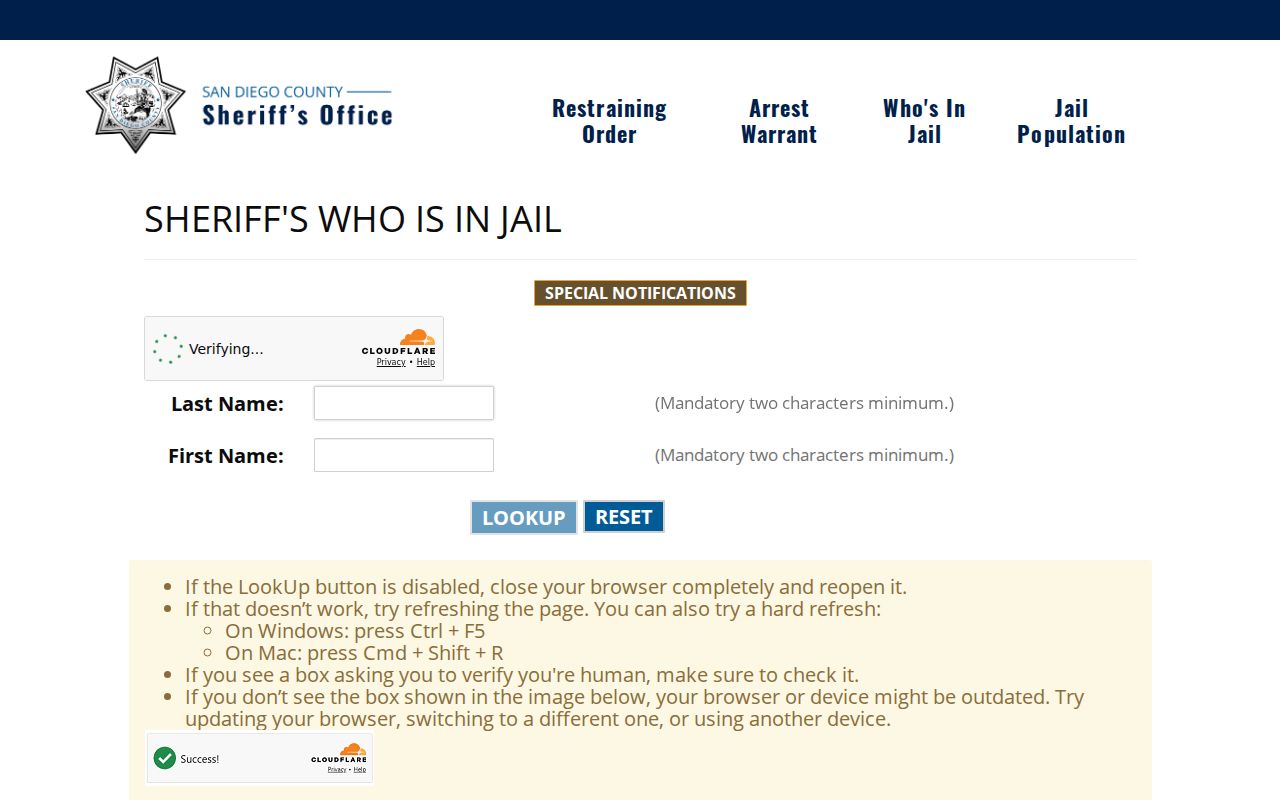
Custody data changes as operations change. Incident or arrest reports for Sheriff-policed areas go to Sheriff records rather than the Lemon Grove city clerk, and disclosure can depend on Penal Code, privacy, victim, and investigative exemptions.
The California Department of Corrections and Rehabilitation locator searches by last name, first name, or CDCR number for prison custody, location, and basic status.
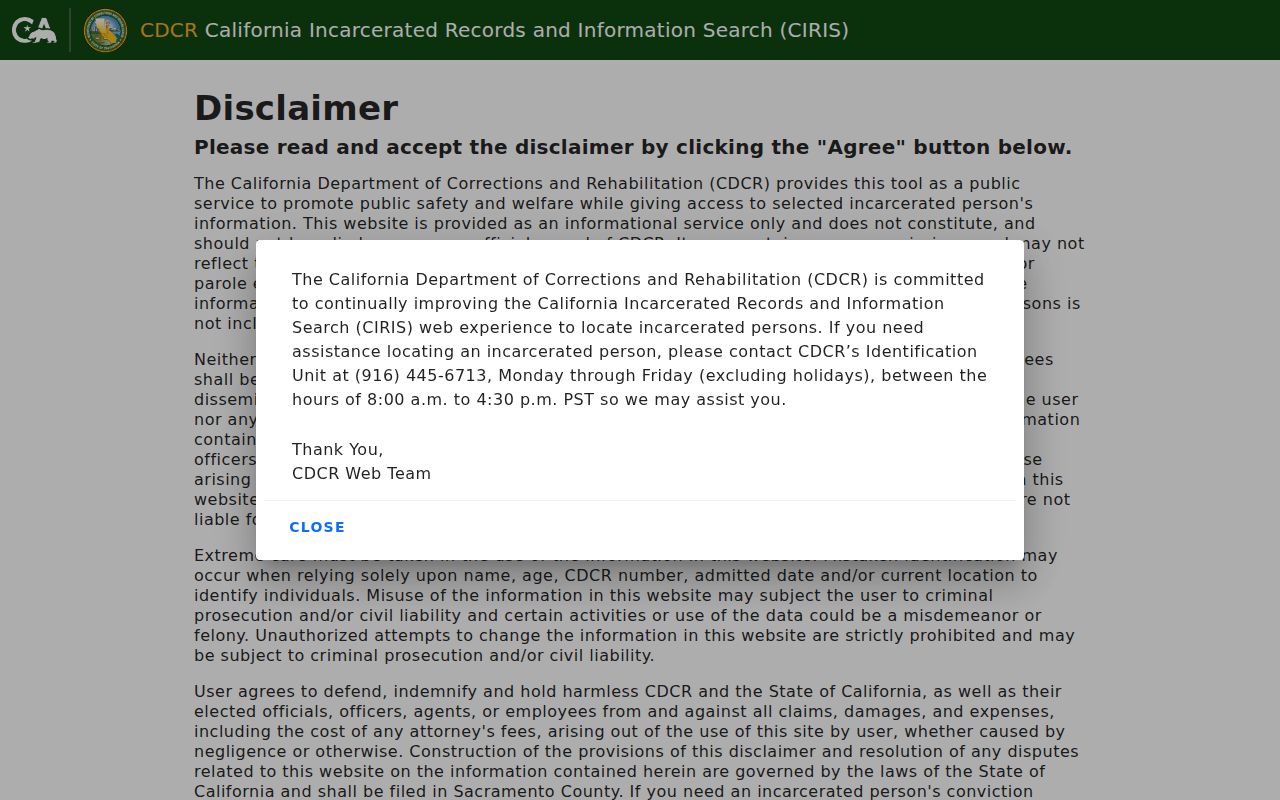
CDCR’s locator is not a complete criminal-history source. Match the name with the available identifier and keep the search question limited to the custody information the tool publishes.
California Megan’s Law offers name, map, address, and radius modes with a registrant profile and mapped disclosure level.
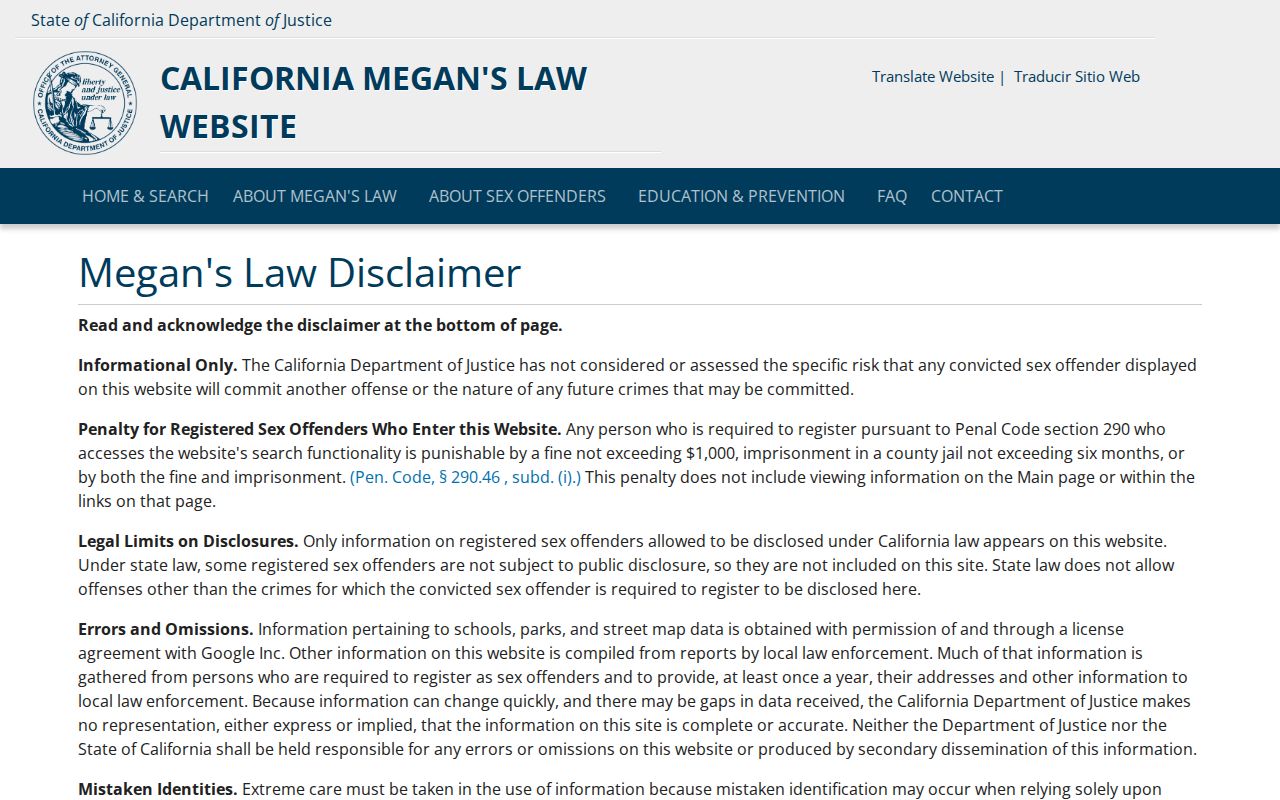
Statutory use warnings and excluded or confidential categories apply. Do not equate an arrest, booking, or registry match with identity certainty or present dangerousness. Confirm identifiers and official disposition, and never use a result to threaten or intimidate anyone.
Trace a Lemon Grove Heir Through Probate
Probate is a human-use route for an heir or a deceased resident, not a shortcut to private family data. Start with the decedent’s name and an approximate date, then use the court index to locate the probate matter. Petitions and orders can connect names, relationships, and estate action, while recorder documents and obituaries help test the trail.
- Search the San Diego Superior Court probate index by the decedent, using a date or name variant to narrow the result.
- Note the case location and request the petition, order, or eligible Register of Actions record through the court’s access route.
- Follow recorded documents, obituaries, cemetery leads, and a death informational copy without republishing sensitive certificate details.
- Compare spouse names, middle initials, dates, and addresses before treating an heir connection as established.
A deceased Lemon Grove resident may leave a trail through a death index or informational copy, an obituary, probate, a directory, and a deed. A former classmate may be easier to locate through public yearbooks, local newspapers, alumni groups, or the historical society, with consent-based contact. California adoption records are confidential. A birth-parent search should use CDSS or CDPH court-authorized and mutual-consent mechanisms rather than trying to defeat a seal. Historical address work can also be paired with Lemon Grove city directories held in regional collections.
Lemon Grove Business Names in Public Filings
A business name can supply a useful public affiliation when a person is known through a storefront, permit, filing, or professional role. Begin with bizfile Online by entity name or entity number. Where offered, advanced status and type filters narrow the result. The filing may show a legal name, entity number, status, formation, agent or address, and document history.
Next compare the name with a San Diego County fictitious business name filing. The FBN search can connect a public storefront name to a registrant, filing dates, and status. For a regulated professional, the California Department of Consumer Affairs license search accepts board or license type, license number, personal or business name, and city or county. A result may show license status, address, issue or expiration information, and links to discipline records when the board supplies them.
Read the role before drawing a conclusion. An agent for service is not necessarily the beneficial owner. A mailing address is not necessarily a residence. A dissolved entity can be useful for past research but does not prove current activity. Cross-check the entity, FBN, and relevant city permit while preserving the dates shown by each filing.
Lemon Grove Privacy and Corrections
California privacy law gives qualifying consumers rights to know, delete, correct, limit sensitive-data use, and opt out of sale or sharing where the law applies. The California Consumer Privacy Act is described by the Attorney General’s CCPA guidance. The DELETE Act adds the Delete Request and Opt-out Platform, or DROP. Starting in January 2026, Californians can register with DROP to direct registered data brokers through one request. Check current California implementation instructions before relying on a process.
- Find the privacy or consumer-request route for a commercial compilation service, then choose deletion or opt-out.
- Identify the record URL without sending more personal data than the request needs.
- Complete the required verification, keep the confirmation, and note the date of the request.
- Recheck the result and use the CCPA or California Privacy Protection Agency complaint route if a covered business does not respond.
Safe at Home gives qualifying survivors and other specified people a substitute mailing address and confidential voter procedure. Government Code §6208.1 restricts publication after a qualifying written demand and intentional harmful publication, while §6209.5 addresses substitute-address use in real-property documents. The program does not retroactively erase every existing record. DMV addresses are also protected under the federal DPPA.
Recorded documents may contain sensitive identifiers. Ask the Recorder about statutory redaction or correction procedures, because an ordinary CPRA request does not alter an instrument. Modern voter information remains restricted under Elections Code §2194 even when other public records can be corrected or deleted.
Note: A correction request depends on the record keeper and cannot turn a restricted record into an open one.
Lawful Limits on Lemon Grove Resident Lookup
A Lemon Grove resident lookup is appropriate for personal, lawful research such as family history, an estate question, a reunion, civic records review, or verification with the custodian. California Penal Code §646.9 addresses stalking, and Code of Civil Procedure §527.6 provides a civil-harassment remedy. Elections Code §18109 adds a specific warning for unauthorized voter-information use, while Megan’s Law carries its own statutory use limits.
Lawful use. Use a Lemon Grove resident lookup only for personal, lawful research and respectful contact. Do not use an address, registry match, court entry, or other record to stalk, follow, threaten, intimidate, or repeatedly contact a person.
A missing record may reflect a sealed case, confidential vital record, protected voter, Safe at Home participant, or a limit in the online index. The right next step is the relevant custodian, not a more aggressive search. Verify the record, protect the person’s information, and stop when the lawful purpose ends.